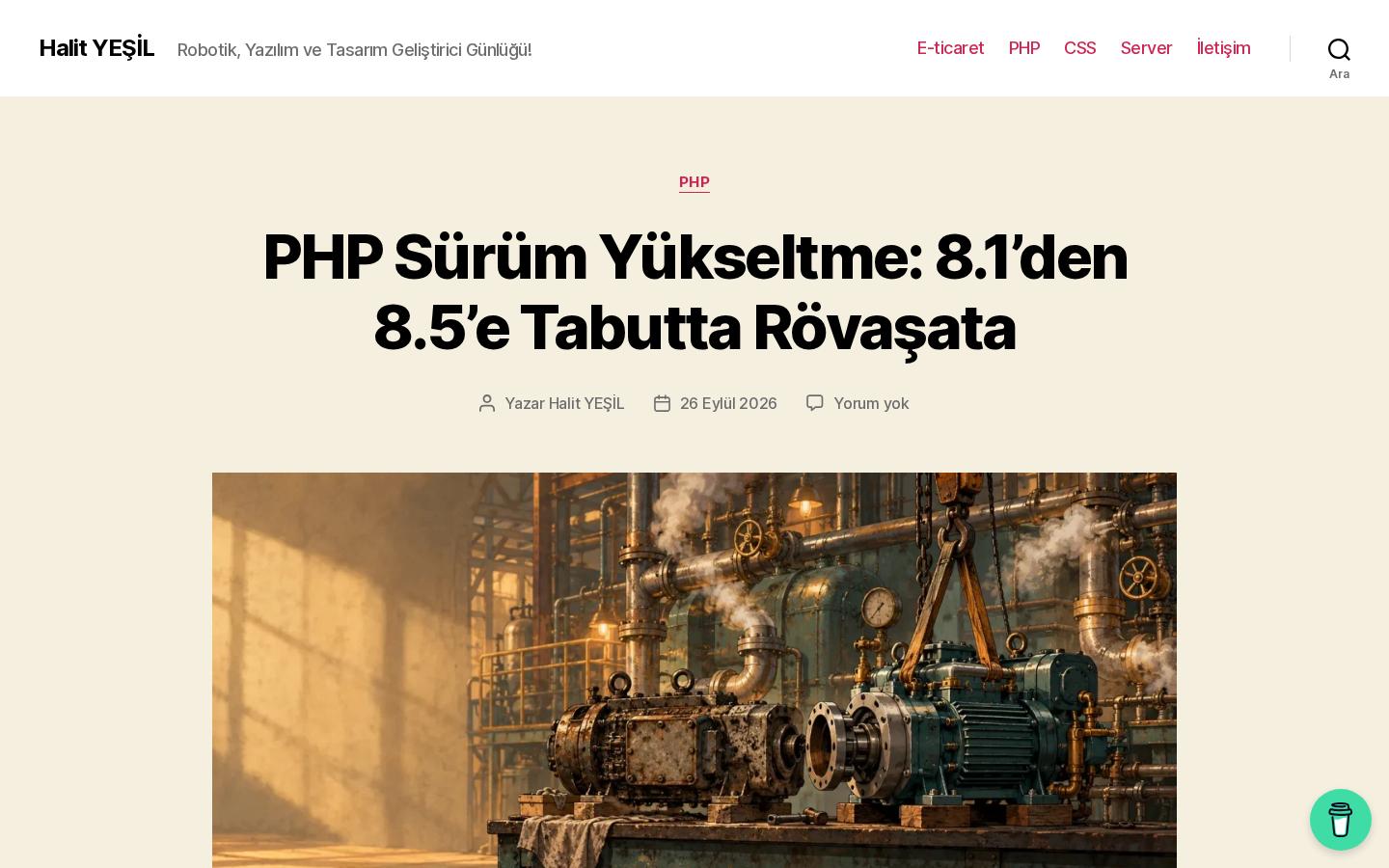
What is Halityesil.com?
Halityesil.com is the personal website and technical journal of Halit Yeşil, one of Globya's co-founders. Its tagline translates as "A Robotics, Software and Design Developer's Journal!" The site features posts on PHP, databases, CSS, JavaScript/TypeScript, Linux server administration, e-commerce and, more recently and intensively, AI-assisted software development.
You can read the journal at halityesil.com; some of the posts are also published in English.
Starting point
Developers rarely write down the problems they solve during the day, and then run into the same problem again a few months later. Halityesil.com turns those notes into a public journal: the traps you hit while upgrading PHP on a server, setting up a framework, positioning images with CSS, or how AI tools affect the development process. Every post starts from a real job and a real problem.
What's on the site?
- Main menu: E-commerce, PHP, CSS, Server and Contact.
- Categories: PHP (with MySQL and Phalcon subtopics), Artificial Intelligence / AI, Vibe Coding and the "Vibe Coder's Handbook" series, Linux and CentOS, JavaScript/TypeScript, CSS, E-commerce, Reviews, Code Wars, a "Survival Guide for Developers," useful services and good ideas.
- Series: the "Vibe Coder" series covers topics such as architectural decisions, database and schema management, AI-assisted development environments and front-end prototyping, episode by episode.
- Tag cloud: topics such as Laravel, Symfony, Next.js, Supabase, Tailwind CSS, Python, LLMs, open source and clean code.
- English section: English versions of selected categories and posts.
- Social media links and contact via WhatsApp.
Key solutions
Long-running content
The sitemap lists 85 posts (September 2026). The first posts go back to 2020, and the busiest publishing period is 2026. Writing regularly is the most reliable way for a personal website to gain strength in search engines over time.
A friendly but technical voice
The headlines are written in a distinctive, curiosity-sparking voice (think "PHP Version Upgrade — a Bicycle Kick from 8.1 to 8.5 Inside the Coffin"), while the content is step by step and practical. That balance is what makes a technical blog readable.
Bilingual structure and SEO foundation
The site runs on WordPress with the Yoast SEO plugin. The Turkish and English versions are linked with hreflang, and category and post sitemaps are generated separately. Pages carry CollectionPage, BreadcrumbList and WebSite (including site search) schema. Cookie and KVKK (Türkiye's Personal Data Protection Law) notices are in place as well.
Analysis table
| Item | Status |
|---|---|
| Platform | WordPress + Yoast SEO |
| Language | Turkish, English (hreflang) |
| Content volume | 85 posts, 25+ categories |
| Publishing period | From 2020 to today, busiest in 2026 |
| Structured data | CollectionPage, BreadcrumbList, WebSite |
| Series content | Vibe Coder series, survival guide |
| Contact | Contact page, social media, WhatsApp |
| Mobile | Responsive design |
What we learned from this project
- A real problem is the best source of content. A post about a problem someone actually lived through and solved gets read and shared more than a generic guide.
- Series bring readers back. An episodic format gives visitors a reason to wait for the next post.
- Personal expertise turns into corporate trust. When the team writes about its own field, clients get the feeling "I'm working with people who know this."
The topics Halit Yeşil writes about are the kitchen of the work we do at Globya every day: e-commerce platforms, server maintenance, databases and AI-assisted development. Related services: e-commerce, hosting and maintenance, custom software, SEO and GEO. For our e-commerce platform: IMFLEXI.
Who is Halit Yeşil?
He is the co-founder and software developer who founded Globya together with Emre Yakut. On his personal website he writes about PHP, AI, e-commerce and server administration.
Can you set up a blog for our company too?
Yes. We set up the blog platform, work out the category structure and publishing plan with you, and support you with content production as well.
How does a technical blog help SEO?
Every post is a new page that answers someone searching for a specific problem. Regular publishing gradually gives the site strong search visibility.